
 When a production line needs attention, a spill needs cleanup, and another delivery is waiting at the dock, which job gets your team’s time? For operations leaders, that’s where the automation conversation gets practical.
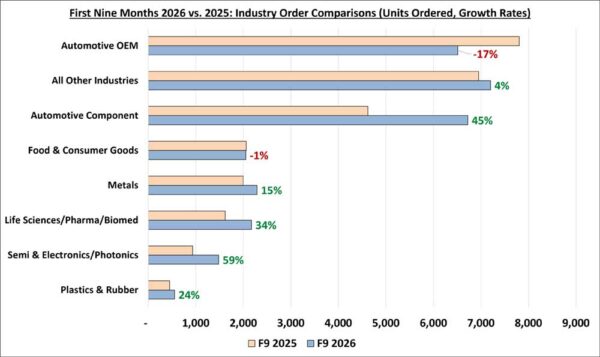
North American companies ordered 10,989 industrial robots valued at $723.5 million in the third quarter of 2026, according to the Association for Advancing Automation (A3). Compared with the same quarter last year, orders rose 24.8% by volume and 26.1% by value, making it the strongest quarter of 2026 through September.
The report tracks industrial robot orders. For manufacturers and warehouse operators considering other kinds of automation, including autonomous floor cleaning and material movement, it’s a timely reason to look at where routine work is competing for employees’ time.
Robot orders climbed across several manufacturing sectors
Automotive component suppliers ordered 90.4% more robots than they did a year earlier. Orders in semiconductors, electronics, and photonics rose 97.6%, while plastics and rubber rose 67.7%. The gains varied by sector, with food and consumer goods orders falling 23.7% over the same period.
That variation matters when you’re deciding where to invest. A plant manager might need more consistent floor cleaning between shifts. A distribution center might want to cut the number of trips employees make between staging and packing. Each has a different starting point and a different way to measure success.
Find the repetitive work your team would gladly hand off
Ask the people doing the work which tasks pull them away from higher-priority responsibilities. Two places to look are floor care and routine material movement.
In a manufacturing facility, an autonomous sweeper could handle a scheduled route through designated aisles while the facilities team focuses on detail work and areas that need closer attention. In a warehouse, a mobile robot could carry totes along a repeatable route from packing to staging, giving employees more time to verify orders and handle exceptions.
The value depends on what happens during a normal shift. A cleaning route that works in an empty aisle may need to change once forklifts are moving and pallets are staged. A tote delivery route is only useful if the robot arrives when the next team needs it. Bring frontline employees into the pilot early. They know where traffic backs up, which routes change, and what will make the robot useful on a busy day.
Start with one workflow and measure what changes
- Pick a task you can observe. Choose one cleaning zone or material transport route. Record how often the task happens, how long it takes, and what gets in the way.
- Pilot it during a normal shift. Track completed routes, interruptions, and how often someone needs to step in. Ask the team whether the robot makes their work easier and where the handoff needs improvement.
- Check where the time goes. If the pilot gives employees time back, see how they use it. Depending on the operation, that might mean more time for inspections, order accuracy, or detailed cleaning. Include setup, training, and ongoing support when assessing the return.
Start simple. Scale what works.
At Impact Robotics, we help teams evaluate where commercial robots can take on repetitive work and give people more time for the parts of the job that need their judgment and attention. If you already have a cleaning zone or transport route in mind, bring it to a conversation with our team. You can also see commercial robots in action near you.